01The Billion-Dollar Question
When you're serving 2 billion logged-in users per month like YouTube, every architectural decision has massive implications on infrastructure costs. Let's break down why YouTube chose Server-Sent Events (SSE) over WebSockets, and how this "simple" choice saves millions of dollars annually.
02Understanding the Use Case
YouTube needs to push real-time updates to users:
- 📹 New video notifications from subscribed channels
- 💬 Live chat messages during streams
- 👍 Like count updates
- 🔔 Community post notifications
- 📊 Live streaming viewer counts
Key insight: Notice something? All these are one-way communications - server to client. Users don't need to send continuous data back to the server.
03The Cost Breakdown: SSE vs WebSockets
Let's examine the infrastructure requirements and costs for each approach.
04WebSockets: The Heavyweight Champion
Connection Type: Full-Duplex (Two-way) Protocol: Custom WebSocket protocol Connection Management: Complex sticky sessions required
- Load balancers need sticky sessions (session affinity)
- Connections must stay on the same server
- Complex horizontal scaling
- Higher memory footprint per connection (~8KB per connection)
- Custom protocols require special proxy/CDN handling
05Cost Impact at YouTube Scale
WebSocket Infrastructure:
2 billion users × 8KB memory per WebSocket = 16 TB RAM
- Dedicated WebSocket servers (can't easily share with HTTP)
- Special load balancer configurations
- CDN complexity/bypass costs = Massive infrastructure costs
06SSE: The Efficient Contender
Connection Type: Half-Duplex (One-way) Protocol: Standard HTTP/HTTPS Connection Management: Standard HTTP load balancing
- Works with standard HTTP load balancers (no sticky sessions!)
- Easy horizontal scaling
- Lower memory footprint (~2KB per connection)
- HTTP/2 multiplexing support
- Works through standard CDNs and proxies
07SSE Cost Impact at Scale
SSE Infrastructure:
2 billion users × 2KB memory per SSE = 4 TB RAM
- Can share existing HTTP infrastructure
- Standard load balancing (no special config)
- CDN friendly (works like regular HTTP) = 75% less cost than WebSockets!
08Real-World Cost Savings
Let's do some back-of-the-envelope math for YouTube's scale:
09Scenario: 100 Million Concurrent Users
WebSocket Approach:
Server Requirements:
- 10,000 dedicated WebSocket servers (10K connections each)
- Each server: $200/month
- Special load balancers: $5,000/month each × 100
- Monthly cost: $2,500,000
Memory: 100M × 8KB = 800 GB Bandwidth overhead: ~20% higher (WebSocket frame overhead)
SSE Approach:
Server Requirements:
- Can use existing HTTP infrastructure
- 3,000 servers handling multiple duties (33K connections each)
- Each server: $200/month
- Standard load balancers: Already in place
- Monthly cost: $600,000
Memory: 100M × 2KB = 200 GB Bandwidth overhead: Minimal (standard HTTP)
Annual Savings: ~$22.8 million 🎉
10Technical Advantages Beyond Cost
SSE provides several technical advantages that go beyond just cost savings.
11 HTTP/2 Multiplexing Magic
One TCP connection can handle multiple SSE streams:
1// One TCP connection, multiple SSE streams
2GET /notifications → Stream 1
3GET /live-updates → Stream 2
4GET /chat → Stream 3
5// All over ONE TCP connection!
WebSockets require separate connections for each stream.
12 Automatic Reconnection
SSE handles reconnection automatically:
1// SSE handles this automatically
2const eventSource = new EventSource('/events');
3// If connection drops, browser auto-reconnects
4// and sends Last-Event-ID to resume from where it dropped
With WebSockets, you must implement this yourself with manual retry logic and state tracking.
13 CDN & Proxy Friendly
SSE uses standard HTTP, so it works seamlessly with:
- Cloudflare
- Akamai
- AWS CloudFront
- Corporate proxies
- Firewalls
WebSockets often get blocked or require special configuration.
14 Infrastructure Reuse
YouTube's existing infrastructure:
- HTTP Load Balancers ✅ (SSE works here)
- Nginx/Apache servers ✅ (SSE works here)
- CDN layer ✅ (SSE works here)
- DDoS protection ✅ (SSE works here)
- Rate limiting ✅ (SSE works here)
- Monitoring tools ✅ (SSE works here)
No need for separate WebSocket infrastructure!
15When WebSockets Would Cost More
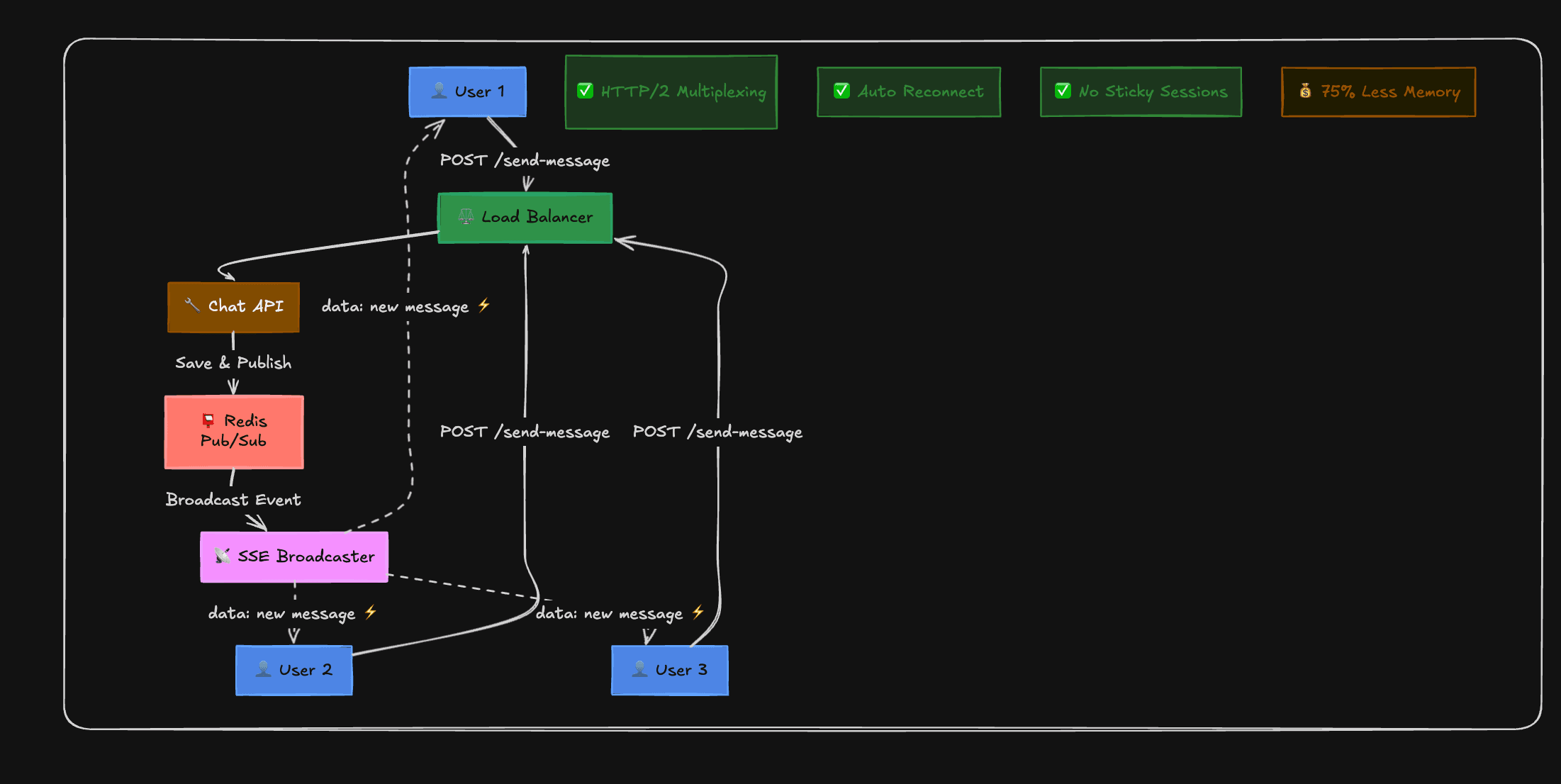
Let's examine a bidirectional chat application at scale:
16WebSockets for Chat
Advantages:
- ✅ Native bidirectional support
- ✅ Lower latency for client → server
Disadvantages:
- ❌ More complex infrastructure
- ❌ Higher memory per connection
17SSE + HTTP POST for Chat
Approach:
- ✅ SSE for server → client messages
- ✅ Regular HTTP POST for client → server messages
- ✅ Simpler infrastructure
- ✅ Lower memory usage
- ⚠️ Slightly higher latency for client messages (negligible for chat)
Verdict: For most chat applications, SSE + POST is still more cost-effective!
18The Hidden Costs of WebSockets
WebSockets introduce several hidden operational costs.
19 Sticky Sessions Nightmare
WebSocket Problem:
User connects to Server A Server A goes down User gets routed to Server B WebSocket connection lost → Must reconnect
SSE Solution:
User connects to any server Server goes down → Auto-reconnects to any available server No session stickiness needed!
20 Scaling Complexity
Adding new WebSocket servers:
- Update load balancer config
- Ensure session persistence
- Drain existing connections
- Test sticky session routing
- Monitor connection distribution
Adding new SSE servers:
- Add server to pool
- Done! ✅
21 Monitoring & Debugging
WebSocket debugging:
- Custom tools needed
- Binary frames harder to inspect
- Connection state tracking complex
SSE debugging:
- Standard HTTP tools work
- Plain text events
- curl works out of the box!
22YouTube's Architecture Wins
By choosing SSE, YouTube gets:
- 💰 Lower Infrastructure Costs - 75% less memory per connection, no special WebSocket servers, standard load balancing
- 📈 Better Scalability - Easy horizontal scaling, no sticky sessions, HTTP/2 multiplexing
- 🛠️ Simpler Operations - Use existing HTTP stack, standard monitoring tools, easier debugging
- 🌍 Better Global Performance - Works through CDNs, no proxy issues, firewall friendly
- ⚡ Built-in Resilience - Automatic reconnection, event ID tracking, browser-native support
23Code Comparison: The Simplicity Factor
Let's compare the implementation complexity:
24WebSocket Server (Complex)
1// Requires special WebSocket library
2const WebSocket = require('ws');
3const wss = new WebSocket.Server({ port: 8080 });
4
5wss.on('connection', (ws) => {
6    // Manual ping/pong for health check
7    ws.isAlive = true;
8    ws.on('pong', () => ws.isAlive = true);
9
10    // Send message
11    ws.send(JSON.stringify({ type: 'notification', data: '...' }));
12});
13
14// Manual cleanup of dead connections
15setInterval(() => {
16    wss.clients.forEach((ws) => {
17        if (!ws.isAlive) return ws.terminate();
18        ws.isAlive = false;
19        ws.ping();
20    });
21}, 30000);25SSE Server (Simple)
1// Uses standard HTTP
2app.get('/events', (req, res) => {
3    res.setHeader('Content-Type', 'text/event-stream');
4    res.write('data: notification\n\n');
5    // Connection cleanup handled by HTTP layer
6});
SSE is literally 4 lines vs 20+ lines for the same functionality!
26The Bottom Line
For YouTube's use case:
- ✅ Only need server → client communication
- ✅ Millions of concurrent connections
- ✅ Standard HTTP infrastructure available
- ✅ Global CDN distribution needed
- ✅ Cost optimization critical
SSE is the obvious choice.
WebSockets are great for:
- Real-time multiplayer games (constant bidirectional data)
- Collaborative editing (like Google Docs)
- Trading platforms (microsecond latency matters)
But for notifications, updates, and feeds? SSE saves millions while being simpler.
27Takeaway for Your Projects
Ask yourself:
- Do I need bidirectional communication? No → Use SSE Yes → Still consider SSE + HTTP POST
- Do I need ultra-low latency (<100ms)? No → Use SSE Yes → Consider WebSockets
- Am I optimizing for scale and cost? Yes → Use SSE No → Either works
Rule of thumb: Start with SSE. Only upgrade to WebSockets when you have a proven need for bidirectional real-time communication.
28Conclusion
YouTube didn't choose SSE because it's "good enough" - they chose it because it's the optimal solution for their specific needs. When serving billions of users, every architectural decision matters, and SSE provides the perfect balance of simplicity, cost-effectiveness, and scalability.
For most applications requiring real-time server-to-client updates, SSE is not just a viable option—it's often the best choice. The cost savings, operational simplicity, and infrastructure reuse make it a compelling solution for any application at scale.